Table of Content
[Video] SUSTAERO CEO Keith Gillard Outlines Billion-Litre Sustainable Aviation Fuel Vision at Global Energy Show

Table of Content

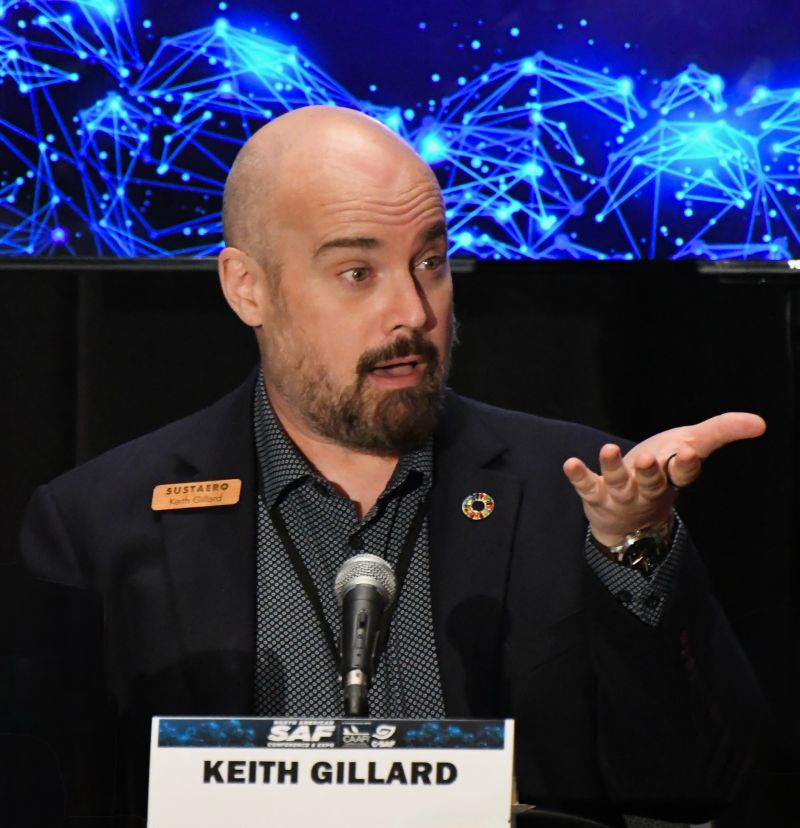
CALGARY, AB, June 11, 2026: Yesterday, SUSTAERO Co-Founder and CEO Keith Gillard took the stage at the BMO Centre for the Global Energy Show Canada, delivering a compelling presentation as part of the prominent Energy Influencers programme. Appearing as a member of the elite Earth Tech: 2050 cohort (a national accelerator dedicated to scaling climate technologies capable of mitigating half a gigatonne of greenhouse gases), Gillard unveiled SUSTAERO’s master plan to establish Canada as a global powerhouse in the sustainable aviation fuel (SAF) sector.
"Thank you all for coming out to see what we're doing at SUSTAERO today," Gillard began, addressing a packed audience. "We are aiming to be Canada's first billion-litre wood-to-SAF producer."
Backed by Fortune 100 leadership and a fully proven, technology readiness level nine (TRL-9) tech stack, SUSTAERO is positioning itself to deliver the most secure and cost-advantaged SAF on the market, with its first commercial production facility scheduled to come online in Ontario by the end of 2029.
Moving Beyond the "Wings of the Meat Industry"
Gillard demystified what SAF actually is for the audience, clarifying that it is chemically identical to conventional petroleum-based jet fuel. "It is jet fuel. It is kerosene," Gillard explained. "It's the same molecule that is in airplanes right now. In fact, if you flew here, there's a good chance there was some SAF in your tank."
However, Gillard pointed out the fundamental scalability limitations of current global SAF supply chains, drawing a sharp contrast with SUSTAERO's approach. "Now, that SAF that was in your tank was almost certainly made, if you flew Air Canada to get here... in Singapore from beef tallow and used cooking oil. So you flew here on the wings of the meat industry. How scalable is that? Well, we don't think it's very scalable. We think that Canada offers some much better alternatives."
While the global SAF market has already reached $5 billion and is expanding rapidly, Gillard noted that international regulatory environments are driving massive commercial urgency. Even in the absence of federal compliance penalties in Canada and the United States, strict mandates in Europe, Asia, and Australia are forcing airlines to secure fuel or face devastating financial consequences. In Europe, where mandates jump to 6% by 2030, airlines face underutilisation penalties as high as €17,000 per tonne.
Crucially, European mandates specifically target "eSAF" derived from electrolysis and hydrogen. "It turns out that our process, 75% of the stuff that we make is eSAF," Gillard revealed, noting that Canada is forecasted to lead global growth with a massive 106% compound annual growth rate (CAGR) in the coming years.
Activating Canada's Unrivalled Resource Geography
SUSTAERO's commercial strategy relies on a specific chemical pathway: Fischer-Tropsch Synthetic Paraffinic Kerosene (FT-SPK). Gillard highlighted that Canada is uniquely engineered to dominate this space, ranking first globally for commercial forestry, fourth for low-carbon renewable electricity, and third for commercially available fresh water.
The physical linchpin of SUSTAERO's operational model is the strategic upcycling of Canada's 900 shuttered industrial mills, including 120 idled pulp and paper facilities.
"They have everything that we need to make our SAF," Gillard said. "They're blessed with biomass, with water, and with clean, green hydroelectricity. They also have political will to bring jobs and industry back to the rural and Indigenous communities that have been devastated by the collapse of the pulp and paper industry."
Hundreds of Millions of Litres via Localised, Sovereign Logistics
Gillard shared the economics and operational architecture behind SUSTAERO's initial site deployment, which represents an initial capital expenditure of $2.4 billion and is engineered to scale up to 730 million litres of annual production, generating an estimated $2.5 billion in top-line revenue per year.
The site features built-in industrial redundancy, boasting nine local sources of biomass, two water lots alongside regional water rights, and five distinct electricity vectors meeting directly on the property. This tight layout ensures an uninterruptible, continuous manufacturing schedule.
"We are able to make SAF in an uninterruptible way with a total supply chain that extends no more than 150 kilometres away from our site," Gillard stated. "We have to shut down once every three years to switch out our catalyst. Otherwise, we are making SAF 24/7/365. No Strait of Hormuz. No borders, no randomly changed tariffs affecting our customers."
For outbound distribution, the facility is equipped with three indoor rail bays capable of loading 14 tanker cars simultaneously, allowing the site to seamlessly move up to 20 tanker cars per day directly to hub airports like Toronto Pearson International Airport.
The SOAR™ Process: Fully Vetted and Bankable
At the heart of the facility is SUSTAERO's proprietary SOAR™ (Syngas Optimisation for Aviation Renewables) process train. While the specific integrated sequence makes the plant a first-of-its-kind facility, every individual component relies on fully commercialised, TRL-9 technology.
"We gasify the wood, which means we rip it apart at the molecular level," Gillard explained. "Then we use those atoms and we restitch them together through a catalytic process called Fischer-Tropsch to make a synthetic crude, which we then conventionally hydrotreat just like any other fuel refining to make our kerosene."
The SOAR™ system achieves an elite 97% carbon utilization rate, yielding a fuel mix of 75% eSAF and 25% bioSAF. The process delivers a Carbon Intensity (CI) score of just 8.79 grams of CO2 per megajoule, a mark that outperforms 95% of all SAF produced globally, even before accounting for potential future credits like methane mitigation.
Gillard closed the presentation by praising his executive team, giving a special floor acknowledgment to SUSTAERO’s Process Development Lead, Tayebeh Roostaei, who was in attendance. He concluded by reiterating the direct, five-part framework that defines SUSTAERO's value proposition to global markets:
"In summary, SAF: sustainable aviation fuel, but maybe that's not the most important S here. It's not just sustainable AF. It's safe AF. It is scalable AF. It's sovereign AF. And it's secure AF."
Share on






Share on

Recent Blogs




Connect with Sustaero
For investor inquiries, SAF supply discussions, partnerships, or stakeholder engagement, send a note and we’ll respond within one business day.

Sign up for the Frequent Flyer Newsletter
Company
Terms & Conditions